
Tomorrow is September 14. I know that date best as Nas’ birthday, one of my favourite rappers. But starting tomorrow, it takes on a distinct financial significance: the day the Dangote Refinery Initial Public Offering (IPO) goes live. Or, if you prefer its official marketing tagline, “The IPO of the People.”
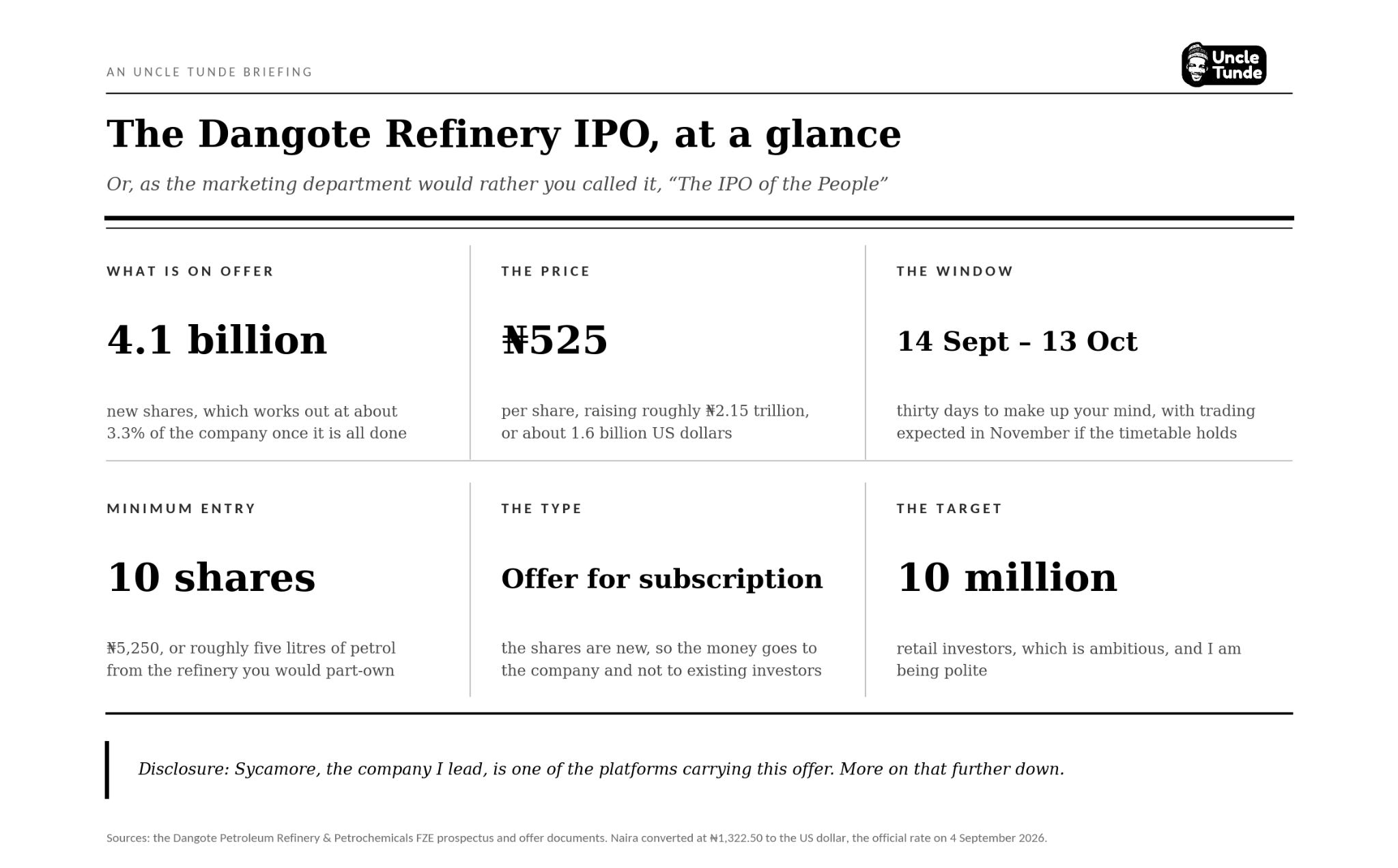
Now that tagline, “The IPO of the People”, tells you a lot about what you need to know about this offering. It literally has everyone talking about it. I have never seen a capital market initiative this hyped in Nigeria. Not Transcorp (more on this later), not Seplat, and not even MTN. And for good reason too. It involves Nigeria’s richest man. It involves fuel, a commodity Nigerians have had a rocky relationship with for several decades. It involves a working local refinery, something many of us didn’t think we’d see in our lifetime. And of course, the Dangote Group has marketed it to the high heavens, getting all major issuing houses and fintechs involved, influencers to amplify it, and using every media opportunity to push the offering.
I knew this IPO was going to be different when one of my oldest friends sent me this message in February this year:
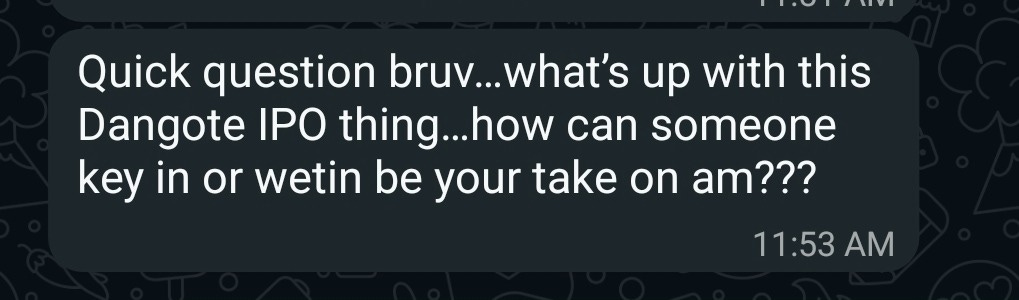
For context, I’ve known this person for over 20 years, and he has never shown any interest in stocks or the capital market in general. I reckon that if Alhaji Dangote could get this person interested, then the marketing machinery must be working!
Unfortunately, this sort of aggressive hype usually comes with extreme claims, some good, some bad and some that just leave you scratching your head. Any way you look at it, excitement and emotions are high, with very few people in the middle. Take this comment for instance:

As you can see, some people are not smiling.
In this article, I examine four such claims, with the aim of putting them into proper context.
By the way, Sycamore, the company I lead, is one of the platforms through which investors can participate in the Dangote Refinery IPO and may earn fees from transactions relating to the offer. Later on in this article, I will share some observations from that experience. Suffice to say, these views are mine, do not represent those of Sycamore, and should not be taken as investment advice.
1. Too good to be true: The ₦525 Share Price will multiply within a short time
I have heard many claims about how the share price could become two or three times its initial value shortly after the stock starts trading in November 2026 (if the indicative timeline holds). This is highly unlikely, to put it mildly. A good place to start is the current market capitalisation and how much it would have to increase for the share price to rise accordingly. The offer price of ₦525 values the company at about ₦63 trillion on the shares that already exist (which is about $47 billion). After the IPO there will be more shares in issue, so that figure becomes about ₦65 trillion, or roughly $49 billion. It is a bigger number because there are more shares, not because the price has moved. Either way, for the share price to double in the short term, all else equal, that would have to become something near $98 billion.
One of the reasons this would be so difficult, though not impossible, is that the current valuation is already seen by several analysts as very high, because the pricing already appears to incorporate some of the expected future cash flows from the planned expansion. The most prominent reports come from CardinalStone, Chapel Hill Denham and Renaissance Capital (you might want to check out the prospectus too if you are reviewing these reports). These are all joint issuing houses for the raise so it’s understandable to be skeptical about them. But the interesting thing is what happens when you separate the value of the refinery as it operates today from the value created by future growth. On certain valuation methods, some of their estimates come in below the ₦525 offer price. The higher valuations tend to emerge when you model future cash flows and successful expansion. The chart below gives you a sense of the difference.
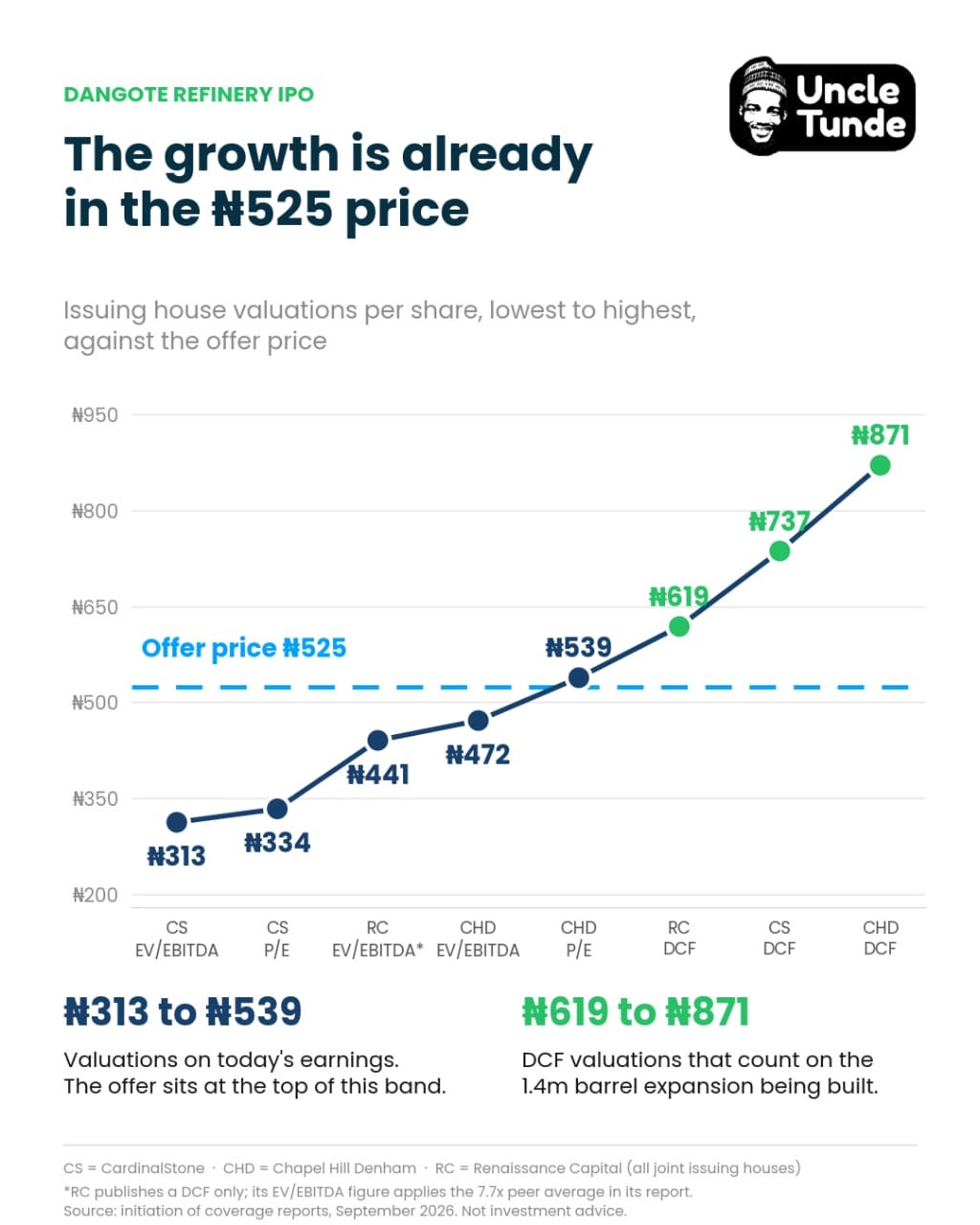
As you can see, potial prices could range from ₦313, all the way to ₦871. So the growth everyone is excited about is not something you are waiting to be rewarded for: it is something you are already paying for at the current ₦525 price. That is the simplest answer to why $49 billion is unlikely to become $98 billion any time soon. And it is also why, when Alhaji references a ₦10,000 target in his remarks, it feels far more like “marketing”, than a financial forecast (at least in the short term).
2. Too bad to be true: This is Transcorp all over again
Many have likened the hype around this Dangote IPO to the Transcorp IPO of 2006. For those that are unfamiliar with the story, the Transcorp IPO was billed as the largest IPO in Nigeria at the time. It was meant to be this conglomerate with diverse business interests that was going to transform Nigeria. The plan was to raise ₦60 billion at ₦7.50 per share. Unfortunately, it wasn’t even fully subscribed, and prices crashed - staying in the ₦1 to ₦3 region for many years after the initial listing. It was painful and heartbreaking to a lot of people who took loans, and liquidated savings to participate in what was expected to be a financial breakthrough.
And I’m not just recounting a story: I was there. As a secondary school student at the time, I heard a lot of hype about this thing called “Transcorp”, and it was probably one of the reasons I understood the word “conglomerate”. I saw first hand how elder members of my family struggled to recover from the losses. A similar phenomenon played out in the banking sector when the banks went to the market to raise money to meet recapitalisation requirements. Subsequent share price performances were poor as well, plus the 2008 global recession only compounded the issues. My good friends at Notadeepdive have done excellent work on this, and you can read more about it here. Interestingly, another feature of that era may also be making a comeback: borrowing money to buy shares. We have already had some Sycamore customers request loans to participate in this listing. Borrowing to invest isn’t automatically disastrous, but it adds another layer of risk: the interest keeps accumulating regardless of what happens to the share price.
All that to say that I understand why anyone who went through this era would feel skeptical about such a hyped IPO. But Transcorp and the Dangote IPO are not the same. Transcorp was more of a new venture with a lot of future potential, while the refinery also controls the Nigerian market for an essential product (as well as exports), is already profitable, and has very concrete expansion plans. Honestly, it’s not a very fair comparison. The only basis for comparison in my view is the promotion. Other than that, they are two substantially different transactions.
3. Too ridiculous to be true: Dangote and Existing Investors want to cash out.
I posted a video on my LinkedIn referencing the prospectus, and saying that the proceeds from the Dangote IPO would partly fund the expansion. There was a particular comment that made me laugh:
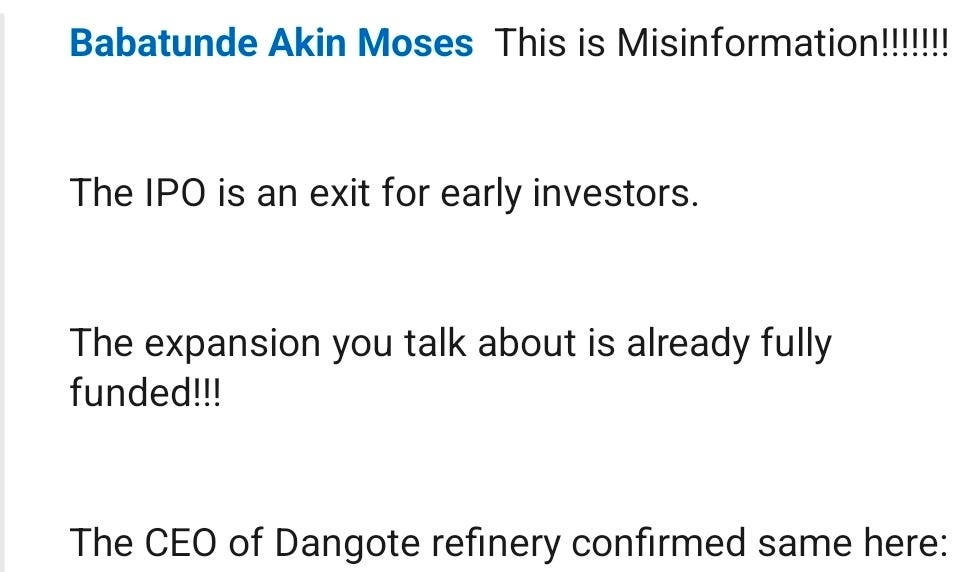
Feel free to ignore the multiple exclamation marks.
To be fair to him, there is a real inconsistency here. The Refinery CEO says the expansion is already fully funded and the prospectus says the proceeds will partly fund it. Those two statements are in conflict, and anyone who notices is making a valid observation. Where I disagree is the conclusion he drew from it. He assumed that if the expansion is already funded, investor exit must be the only other use of the proceeds. I explained that this IPO is an offer for subscription. That means new shares are being issued and the proceeds go to the company. So this particular offer is not an exit for existing investors.
I didn’t even bother explaining that investors who came in during the private placement entered at 35 cents per share, or about ₦475 at the exchange rate at the time. At an IPO price of ₦525, that represents a “paper” gain of only about 10%. In any case, those investors are subject to a 365-day lock-up period, so they wouldn’t even have been able to dispose of the shares during this period.
Sadly, I couldn’t convince the person who dropped this comment, as he simply reiterated that because of the CEO’s statement, the IPO must be an exit for existing investors. A man can only try.
4. Too dangerous to believe: You cannot lose money on this investment
There’s no investment that’s absolutely guaranteed, regardless of how brilliant its promoter is, whether in the short term or long term. Like all businesses, the Dangote Refinery IPO carries some pretty significant risks.
The refinery still has to secure crude at prices that work, keep a single-train plant running, deliver a $14.3 billion expansion, and manage the politics of being the dominant domestic refiner in an election cycle. The financials turned sharply positive by mid-2026 after losses in 2025, but one strong half year is not a track record per se. There are also things in the reports most readers will not bother checking: like the naira-for-crude agreement expiring in July 2027 and the free zone tax exemption on domestic sales scheduled to end in January 2028. Before you start shaking out of fear, I’m not saying all these make it a bad investment. It just means it is an investment, and the prospectus tells you more than any promotional video will.
And in case you still doubt and insist that you can never lose on an IPO of this magnitude, let me point you to how other prominent companies have performed since their shares became public, including Dangote Cement:
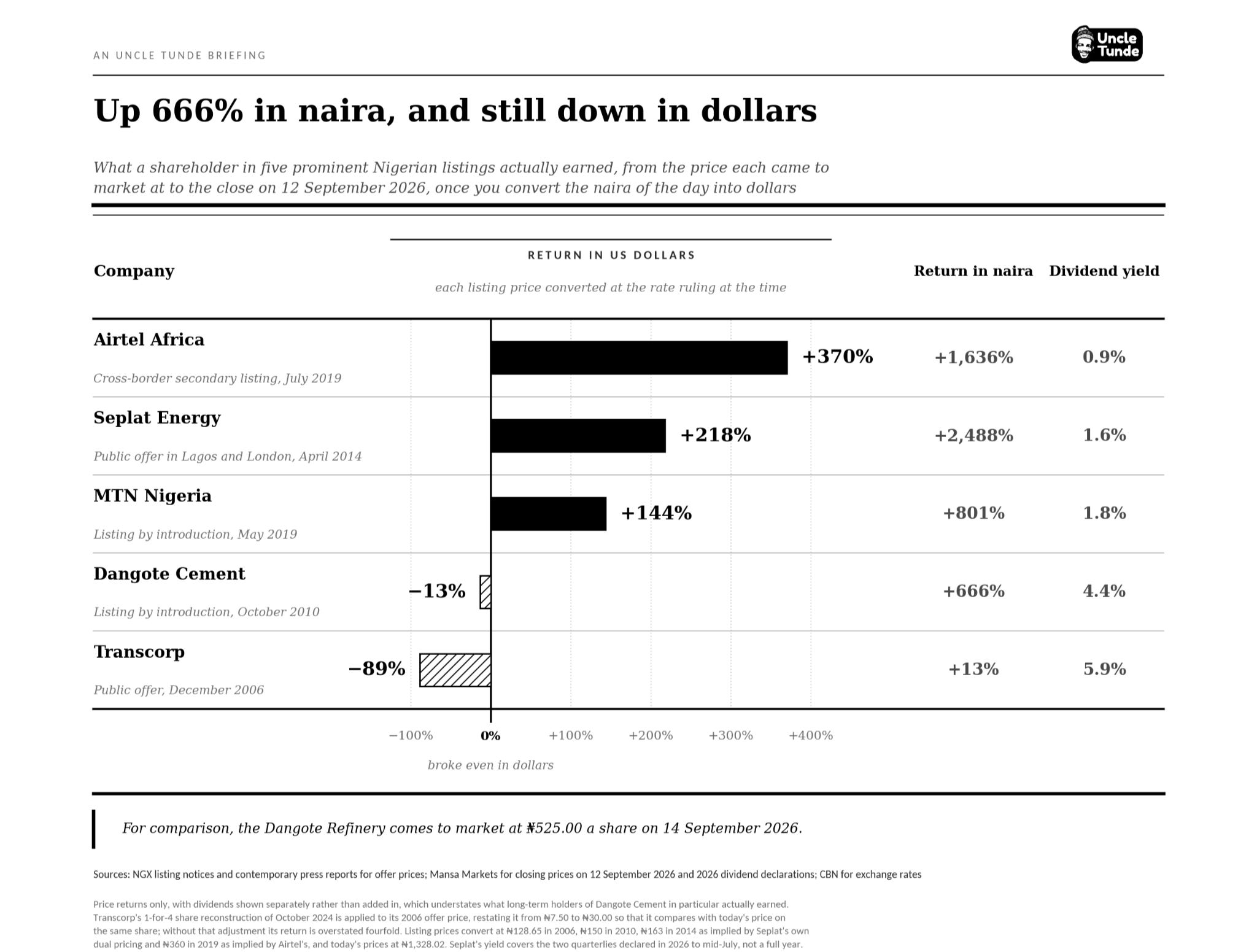
I think this chart pretty much speaks for itself. It never ceases to amaze me how great naira returns shrink once you convert it to dollars. It is what it is.
An IPO of Contradictions
One interesting dynamic of this IPO for me is that it is a cocktail of contradictions. It is an “IPO of the People”, even though the shares being offered will represent only 3.3% of the company once the exercise is concluded. Brilliant marketing by the Dangote Group regardless, and a lesson for us entrepreneurs in the power of creating a sense of belonging. Dangote has somehow turned the purchase of a financial security into participation in a national event.
There is another funny contradiction. Anyone who participates may now find themselves viewing developments in Nigeria’s fuel market through two different lenses: as a consumer who wants cheaper fuel, and as a shareholder who wants the refinery to make more money. Don’t you just love the ironies?
History in the Making
This IPO is going to be a major landmark event, and how you see it will depend on your lens. If you’ve never been a fan of Alhaji Dangote, you may see it as a monopolist expanding his empire and strengthening his hold over the state, as some have put it. Others may simply see an investment opportunity. There were even sell-offs in the market this week as some investors tried to raise liquidity to participate in the IPO. So much liquidity is being redirected towards this IPO that I already know of at least one commercial paper issuance struggling to raise money in this environment. This is probably not the best season to be raising capital in this part of the world.
The reach has surprised me. Sycamore has customers in the UK, Canada and Australia asking how they can participate, people who have never bought a Nigerian security in their lives. Whatever else this offer does, it has pulled in money and attention from places the Nigerian capital market has never reached.
There are also positive ways to view it. The refinery has already changed Nigeria’s fuel supply equation and reduced our dependence on imported refined products, with real benefits for the country’s balance of payments. And the offer itself has got Nigerians talking about shares, equities and Clearing House Numbers, which is a lot of useful financial education for the society as a whole.
Which brings me back to my friend. He may make money or he may lose money. But come November he will be a public equity shareholder, and hopefully a lot more curious about the market than he was back in February. That, for me, is a win.
Thank you for this write-up. It demonstrated how passionate you're in educating Nigerians on the hidden facts behind the Dangote IPO. However, we need to distinguish between traders and investors in share acquisition and disposal. The reasons why people buy differs, short, medium and long term defines who is an investor or trader. When the stock is finally listed and trading commences on it, of course the share price will find its true value. When the share pulls back from say N525 to N400, the traders in the house will pull out leaving the stage for the investors who have positioned themselves for long term run with the company.
Yes, you're right, for an IPO of this nature, there's every possibility of distortion in the valuation of the stock price with future price markup embedded. But the market has a way of correcting that and that shouldn't be used to discourage people from investing.
Many stock analysts are at variance and couldn't come to common terms regarding the pricing. Irrespective of that I want to say that Dangote refinery is a great company and it's a great opportunity to be a part of it's growth trajectory.
Comparing Dangote Refinery with Transcorp is analytical paralysis. Both companies are different in structure and intent. Transcorp idea came as a need to create a special purpose vehicle to accommodate all government companies in a holding company for effective management instead of selling them money bags during the privatization and commercialization exercise of Obasanjo/Atiku government, such that ordinary Nigerian could be a part owner of those enterprises now consolidated under a holding company known as Trans National Corporation (Transcorp, for short). Fantastic idea, but rent seekers who masquerade themselves as investors hijacked the management structure, damaged the stock and turned around to mop up the damaged to emerge as the majority shareholder. And that ends the dream of having the asset of Nigeria in the hands of majority of Nigerians.
Dangote is both a man and an institution who over the years took the risk to built such a massive economic structure that has created massive employment and solved critical national problems. Supporting him with our little resources won't be a bad idea in spite of any negative narration surrounding the stock pricing.
In Nigeria, every seller determines the price of their products. Buyers have little or no control over pricing mechanism. The least any potential buyer could is to shun the product.
Please let Dangote Refinery IPO be. The price is GOOD!
The balance is amazing.
Like late fPMB's famous quip, this piece says, "I am for everyone and for no one".
Proper information publishing, ultimately the decision is yours.
Kudos Uncle Tunde, you did superb justice to the matter with this piece.